
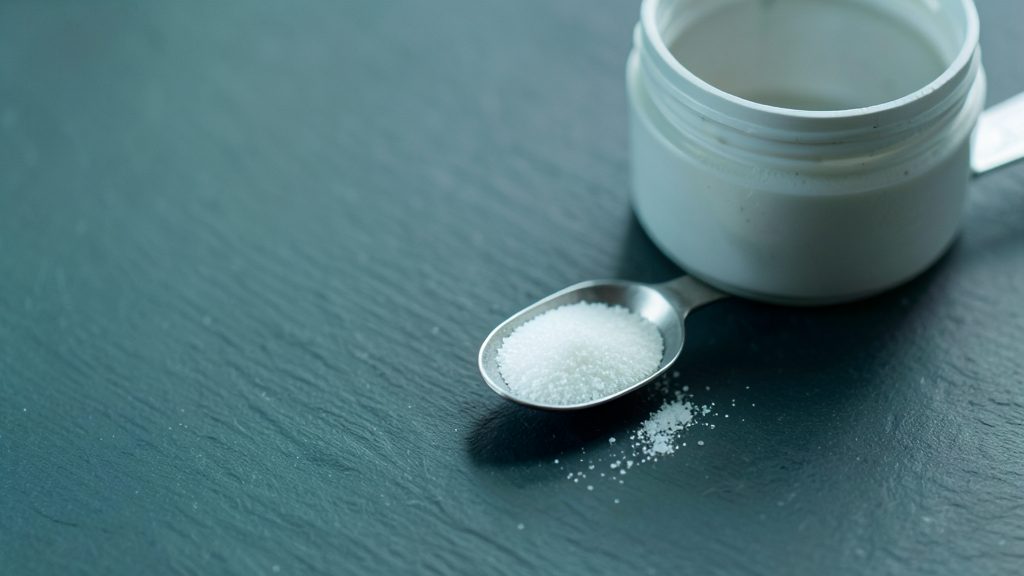
Creatine is the rare supplement where the research and the marketing finally agree. That agreement is exactly what misleads people. The evidence describes a molecule; the bottle in your hand describes a form, a dose and a sales story that survived two decades of corrections.
I’ve watched enough lifting groups argue about this — the “you’ll bloat” camp against the “just take the powder” camp — to know that both sides are describing something real and neither is describing the actual protocol. So here are the questions people really ask, answered with the numbers from the trials instead of the front label.
How much should you actually take?
Maintenance is 3–5 g per day. The loading protocol — 20 g a day split into four 5 g doses for five to seven days — saturates muscle creatine in about a week instead of the three to four weeks you get from a steady low dose, but it doesn’t change the endpoint. It changes how fast you notice, which is why it’s popular and why it’s also the main source of complaints: the first-week weight shift is bigger when you load.
So the practical answer is: load if you want to feel it sooner and can stomach the water shift, take 3–5 g daily if you’d rather not. And no, taking 10 g forever doesn’t buy extra strength once your muscles are saturated — the rest gets converted to creatinine and peed out.
Which form is worth buying?
| Form | The claim | What the data shows | Verdict |
|---|---|---|---|
| Monohydrate (micronized) | The original | ~95% absorbed; largest evidence base; cheapest per gram | Default choice |
| HCl | “Absorbed better, no bloating” | No head-to-head showing greater muscle retention than monohydrate at equal dose | Costs more, buys nothing |
| Ethyl ester | “Better absorption” | Degrades to creatinine in solution; lower blood and muscle levels than monohydrate | Skip |
| Buffered (Kre-Alkalyn) | “pH-stable” | No strength advantage in the crossover work | Skip |
| Gummies | “Convenient” | Usually 2.5 g per serving plus sugar; you’re paying for gelatin | Works, poor value |
| Liquid creatine | “No powder” | Degrades to creatinine over weeks in solution | Skip |
One line summary: buy micronized monohydrate. Every premium variant is a pricing strategy, not a pharmacokinetic advantage.

Will the scale go up?
Usually 1–2 kg in the first two weeks, and it is intracellular water — water pulled inside muscle cells along with the stored creatine, not fat and not subcutaneous puffiness. The people who quit in week three are almost always quitting a water-weight change they misread as fat gain. If you track your waist as well as your weight, this stops being a problem in about a fortnight.
Is it a men’s supplement?
The effect isn’t sex-specific; the trial base is, because most sports research enrolled young men. That gap is closing, and it’s where the field moved fastest between 2021 and 2024 — work on women’s strength, perimenopause and postpartum recovery, partly because women carry lower baseline creatine stores on average. The complaint profile is the same: water-weight perception is the top reason female participants drop out of trials.
Do you have to cycle it?
No. The habit is inherited from an era that assumed the body shuts down its own creatine synthesis if you supplement long enough. Follow-ups in athletes at 12 months and at five years, taking 5–10 g daily, found no adverse markers worth the alarm. The honest version of what happens when you stop: you lose the extra water and part of the training-volume advantage, not the muscle you built.
Is it bad for your kidneys?
This myth is traceable to one study. In 2003, rugby players took 20 g a day for a week, then a maintenance dose; serum creatinine — a normal breakdown product of creatine that rises by chemistry whenever you supplement — went from roughly 106 to 123 µmol/L while measured kidney function stayed normal. Creatinine got read as kidney damage. It’s the single most-repeated supplement scare on the internet, and it’s a lab-value misreading.
The practical guidance on MedlinePlus’s creatine page matches the trial literature: reasonable for healthy adults at typical doses, and a conversation with a clinician first if you already have kidney disease or take medications that affect the kidneys.
Does coffee cancel it out?
The worry comes from a single 1996 study where creatine plus a caffeine dose equivalent to about six cups produced no extra strength over creatine alone. Later work hasn’t reproduced meaningful interference at normal intakes. If you want to be cautious, separate the two by a couple of hours — but don’t trade a supplement you’ve studied for a habit you enjoy.
Before or after training?
Consistency beats timing. A small 2021 trial in trained lifters found a slight edge for post-workout dosing over pre-workout, and the effect size is a rounding error next to simply hitting 3–5 g every day, including rest days. The people who “don’t respond” to creatine are usually people who take it three days a week.
What creatine won’t fix
Three things outrank it, and no gram of monohydrate compensates for them: sleep, total protein and program structure. If you’re sleeping six hours and eating 60 g of protein at 90 kg, creatine is your fourth problem, not your first — sort how often you train and what recovery actually requires first. And if you don’t train at all, the honest comparison isn’t creatine versus nothing; it’s creatine versus the gym.
Who should ask a clinician first
- Existing kidney disease or a history of kidney stones.
- Under 18 — thin data rather than proven harm, and adolescents rarely need the supplement before they need the training years.
- Pregnancy and breastfeeding — not enough human safety data to call it routine.
- Anyone on medications that affect kidney function, including long-term NSAID use.
- Anyone who will read a one-kilogram scale jump as failure and quit in week three.
Evidence note: The dosing and safety picture draws on the International Society of Sports Nutrition’s position stand on creatine (Kreider et al., 2017), the 2003 rugby-player trial that generated the creatinine scare (Creery et al.), and MedlinePlus’s consumer guidance. The short version: 3–5 g of micronized monohydrate daily is the studied, cheap, well-characterized option, and the remaining arguments are about marketing rather than physiology.
Medical disclaimer: This content is general information, not medical advice. Individual needs vary — talk to a qualified clinician or registered dietitian before changing your diet or starting a supplement, especially if you take medication or have a health condition.