
600 milligrams a day. That single number shows up in more ashwagandha trials than any other, and it’s the reason the bottle on the shelf and the capsule in a randomized study can be two different products. Most people buy the herb off the back of a stress-and-cortisol headline, take whatever the label suggests, feel nothing, and file the herb under “doesn’t work.” The gap is rarely the herb. It’s the dose, the extract, and the timeline.
I spent an afternoon pulling the actual trial protocols instead of the marketing pages, and the pattern is consistent enough to be useful. Here’s what the studies used, where the effects held up, who should skip it, and the two claims I no longer repeat.
What the Root Actually Contains
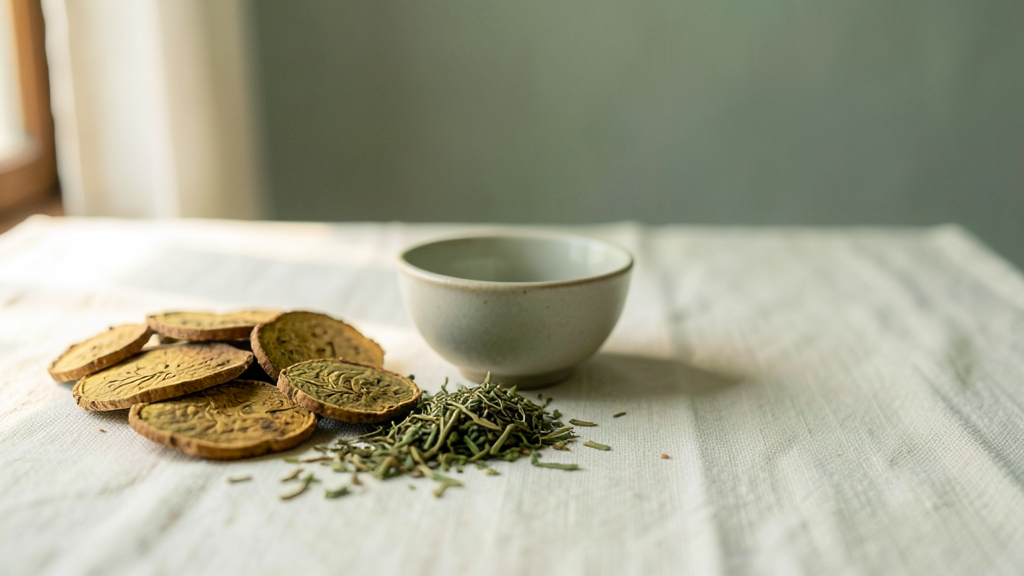
Ashwagandha (Withania somnifera) is an Ayurvedic root, and its active chemistry is a family of steroidal lactones called withanolides. Bulk root powder sold as a culinary or Ayurvedic product typically tests around 0.1–0.3% withanolides. The extracts used in most clinical trials are standardized far higher — commonly 4–7% for root-only extracts, and roughly 10% or more for alcohol extracts that include leaf. Leaf carries withaferin A, the compound that shows up in most of the liver case reports. That distinction matters more than the word “organic” printed on the front of the bottle.
So when someone says “I took ashwagandha for a month and nothing happened,” the first question is never how much. It’s which material. A 1,000 mg scoop of 0.2% root powder delivers less withanolide activity than 250 mg of a 7% standardized extract, and the trials mostly tested the second thing.
The Dose Table Most Trials Agree On
| Outcome studied | Dose used | Duration | What actually changed |
|---|---|---|---|
| Perceived stress, cortisol | 600 mg/day (250 mg twice) | 60 days | Stress score −44% vs −5.8% on placebo; cortisol −27.9% |
| Anxiety (pooled trials) | 240–1,250 mg/day | 6–12 weeks | Small-to-moderate effect, high heterogeneity between studies |
| Sleep onset and quality | 600 mg/day | 8 weeks | Onset a few minutes faster; quality gains small and self-reported |
| Strength, aerobic measures | 500–600 mg/day | 8–12 weeks | Small strength gains over placebo in trained young men |
| Thyroid hormones (hypothyroid) | 500 mg/day | 8 weeks | T3 and T4 rose toward range; a reason to be careful on medication |
Two things jump out of that table. First, the studied dose is usually 600 mg of a standardized extract, not a heaping scoop of whatever the gummy format allows. Second, almost nothing in this literature is measured in under six weeks — the two-week “I feel calmer” reports are mostly placebo timing, and the trials that found effects ran four to twelve weeks.
Stress and Cortisol: The Number Everyone Quotes
The study behind most advertising is a 2012 randomized, placebo-controlled trial of 64 adults with chronic stress. Participants took 600 mg daily of a standardized root extract for 60 days. Their Perceived Stress Score fell 44%, against 5.8% in the placebo group, and serum cortisol dropped 27.9% while DHEA rose 16.5%.
That is a real effect in a real trial. It is also one trial, in 64 people, at one site, using one extract. When the same question gets asked across multiple trials and pooled, the effect on stress and anxiety shrinks to small-to-moderate with wide variation between studies. Translation: a meaningful share of people respond, a meaningful share don’t, and the marketing quotes the best single result as if it were the average.
Sleep: Smaller Than the Ads, and Slower
A 2019 trial gave 600 mg nightly to adults with sleep complaints for eight weeks and measured sleep with actigraphy rather than questionnaires alone. Onset latency improved by a few minutes and self-rated quality improved modestly. If your actual problem is waking at 3 a.m. and not getting back down, that’s a rounding error next to fixing light timing, caffeine cutoff and a consistent wake time — and it’s a smaller effect than the one people report from getting their melatonin dose right, which is a different hormone with a different job.
Strength and Body Composition: Modest, Not Magic
The sports trials are the most flattering and the least generalizable. Young trained men adding 500–600 mg to an existing program gained a bit more strength and lean mass over placebo across 8–12 weeks. Two caveats sit on top of that: the training stimulus was already driving most of the adaptation, and the same literature can’t tell you whether a calmer athlete simply trained more consistently. If your recovery is the bottleneck, rest days and protein timing move the needle further than any adaptogen.
Who Should Skip It
- Pregnancy and breastfeeding. Not enough human safety data; traditional use includes abortifacient contexts.
- Anyone on thyroid medication. One trial in hypothyroid adults saw T3 and T4 rise on 500 mg/day. If your doses are titrated, that’s a lab-value conversation, not a supplement-store decision.
- Autoimmune disease, especially thyroid autoimmunity. Immune-stimulating herbs are a standing caution.
- Regular sedative or alcohol use. It’s mildly sedating and stacks.
- Prior liver injury. Published case reports exist, several in multi-ingredient products where ashwagandha wasn’t the only suspect — which is a reason for caution, not a proven cause.
Buying advice falls out of the same evidence: pick a product that names the extract and its withanolide percentage, not just “ashwagandha root 1,000 mg.” The same logic applies to turmeric, where the studied material and the kitchen powder aren’t interchangeable either.
How to Run an Honest Eight-Week Test
- Week 0 — write down a baseline. Rate your stress 1–10, average sleep hours, and resting heart rate if you have a watch that tracks it. Without this, every later “I think it’s working” is unfalsifiable.
- Weeks 1–2 — dose consistency, not dose size. Same time daily, with food. Note any drowsiness in the first fortnight; that’s the most common early complaint.
- Week 4 — midpoint check. Re-rate stress and sleep. Expect a small shift or none. A dramatic shift at week 2 usually means something else in your life changed.
- Week 8 — decide. If the number moved, continue and re-check at week 12. If it didn’t, stop for two weeks and re-test once before concluding. Some people respond to one extract and not another, and a wash is a legitimate outcome.
Two Claims I Stopped Repeating
“It lowers cortisol in everyone.” The cortisol effect is baseline-dependent. People whose cortisol is already normal have less to gain, which is exactly what the pooled data shows — the effect concentrates in people who were stressed at the start.
“Any powder is the same as the studied extract.” Withanolide content ranges from roughly 0.1% in bulk root powder to double digits in standardized extracts. The trials tested the high end. Buying the low end and quoting the trial is where most of the disappointment comes from.
Evidence note: The stress, cortisol and DHEA figures come from a 2012 randomized placebo-controlled trial of 64 adults published in the Indian Journal of Psychological Medicine, and the broader picture reflects NCCIH’s consumer guidance on ashwagandha plus the pooled trial literature on anxiety, sleep and strength. One trial is not a guarantee, and the honest read is that a subset of people benefit at 600 mg of a standardized extract taken for at least eight weeks.