
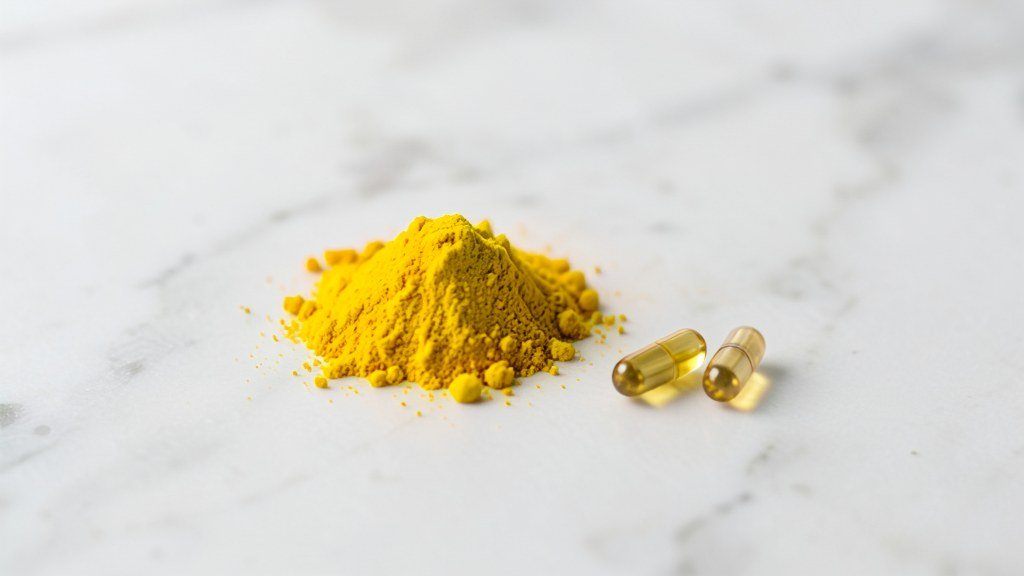
Turmeric and curcumin aren’t the same thing, and the gap between them is exactly why so many people say “I took turmeric for a year and nothing happened.” The yellow powder is roughly 3% curcuminoids. The capsules are concentrated curcuminoids. A clinical trial and a curry are not the same intervention.
I ran both versions – a spoonful of powder most days for a year, then a proper capsule for ten weeks – and the difference wasn’t subtle. Here’s the arithmetic behind it.
The gap between your curry and a capsule
| Source | Curcuminoid amount | Context |
|---|---|---|
| 1 teaspoon turmeric powder (~2.7 g) | ~80 mg | What a generous home cook uses in a pot that feeds four |
| Typical Indian dietary intake | 50-200 mg/day | Population-level estimate, spread across many meals |
| Standardised 500 mg capsule | ~475 mg (95% extract) | The unit dose in most clinical trials |
| Clinical trial range | 500-1,500 mg/day | Osteoarthritis, metabolic and mood trials |
| “Turmeric gummy” or tea | 5-50 mg | Mostly marketing; nowhere near a studied dose |
So the honest question isn’t “does turmeric work” – it’s whether you’re taking a studied dose or a garnish.
Absorption is the actual problem
Curcumin is poorly absorbed: oral bioavailability in the low single digits, and blood levels fall fast. That’s why the formulation matters more than the milligram count.
| Form | What it does to absorption | Evidence status |
|---|---|---|
| Plain extract (curcumin 95%) | Baseline; ~1-3% reaches circulation | Most older trials used this |
| + piperine (black-pepper extract) | +2,000% AUC in humans (Shoba et al., 1998) | Best-known trick; piperine also raises levels of several drugs |
| Meriva (phytosome) | ~29x higher absorption than plain curcumin in dogs, human OA data at 2 g/day | Most osteoarthritis evidence |
| Longvida | Delivers measurable free (unconjugated) curcumin in blood | Cognition and exercise-damage studies |
| Theracurmin | ~27.7x AUC vs crystalline curcumin | Smaller doses (90-180 mg) can match larger plain doses |
And this is where the “natural” argument gets awkward: piperine raises curcumin levels by slowing liver and gut metabolism – the same mechanism that raises levels of several prescription drugs. “Natural” doesn’t mean pharmacologically inert.
What it helps, and what it doesn’t
Reasonable evidence: knee osteoarthritis pain and function (several trials show benefit comparable to modest NSAID effects, e.g. Panahi 2014 at 2 g/day Meriva for 8 weeks); small improvements in fasting glucose and some lipid markers; reduced DOMS after eccentric exercise.
Weak or negative: weight loss; CRP reduction in already-healthy people; depression at low doses (mood trials that worked used 1,000 mg/day or more); “detox” claims, which were never the studied use.
If you’re comparing it to the other supplement people ask me about, our omega-3 dosing guide covers the same problem from the other side – both are anti-inflammatory supplements where the dose and the form decide the result, and both fail more often from underdosing than from being useless.
What I actually take
A Meriva-type capsule at roughly 1 g/day of curcuminoids for ten weeks, then I stopped for a month to see if the effect held (it partly did – the stairs at my office stopped being a negotiation). Before that I drank turmeric milk most evenings for a year and honestly can’t tell you what it did. Related dosing questions handled the same way: iron absorption and how much zinc you actually need.
So is the powder useless?
No – but it’s a different claim. The epidemiological interest in turmeric comes from populations that eat it daily as part of a whole dietary pattern, alongside legumes, vegetables and far less ultra-processed food than the typical Western plate. Nobody has shown that the spice alone explains their outcomes, and a trial can’t easily test “a lifetime of someone’s actual diet.” That’s the honest position: eating turmeric in food is fine and probably mildly beneficial; expecting a food-level intake to reproduce a 1,000 mg trial result is a category error.
The practical version: keep the powder (it’s cheap, and 80 mg per teaspoon is a reasonable baseline), and if you want a therapeutic trial, use a capsule at a studied dose for a defined window instead of scaling the spoon.
How to read a label without being fooled
- Look for “curcuminoids 95%” – not “turmeric root powder 500 mg,” which is the garnish version in capsule form.
- Look for a named delivery form (Meriva, Longvida, Theracurmin, C3 Complex + BioPerine). An unnamed “absorption-enhanced” blend usually means nothing was measured.
- Beware 7-ingredient “inflammation blends” at 50 mg each – boswellia, ginger, bromelain and friends all need their own studied doses, so you get seven sub-doses instead of one real one.
- Check for a third-party test mark (USP/NSF). The supplement-content problem we documented for melatonin applies here too.
Safety, in the order people skip it
- Food amounts are likely safe; supplement doses are “possibly safe” for short-term use – the NCCIH position is 500-1,000 mg/day for up to 3 months, with longer-term safety unestablished.
- Gallbladder problems: curcumin stimulates bile; avoid high doses with gallstones or bile-duct obstruction.
- Iron: curcumin chelates iron and can reduce its absorption – relevant if you’re anaemic (see the iron article above; separate the timing by a few hours).
- Blood thinners: additive effect with warfarin and antiplatelets; stop 2 weeks before surgery.
- Liver: idiosyncratic liver-injury case reports exist with high-dose supplements, and the doses in supplements routinely exceed what food provides.
- Pregnancy: food amounts fine, supplement doses not established.
- Common side effects at higher doses: nausea, diarrhoea, and – less often reported – yellow-stained stools, which people sometimes mistake for something else.
Evidence note: The safety framing follows the US National Center for Complementary and Integrative Health (NCCIH turmeric fact sheet), the piperine pharmacokinetic figure is from Shoba et al. 1998, and the osteoarthritis result cited is Panahi et al. 2014 at 2 g/day Meriva. Responses vary with the formulation and with baseline inflammation, so a supplement that isn’t a studied form or a studied dose can’t be judged by these trials.