
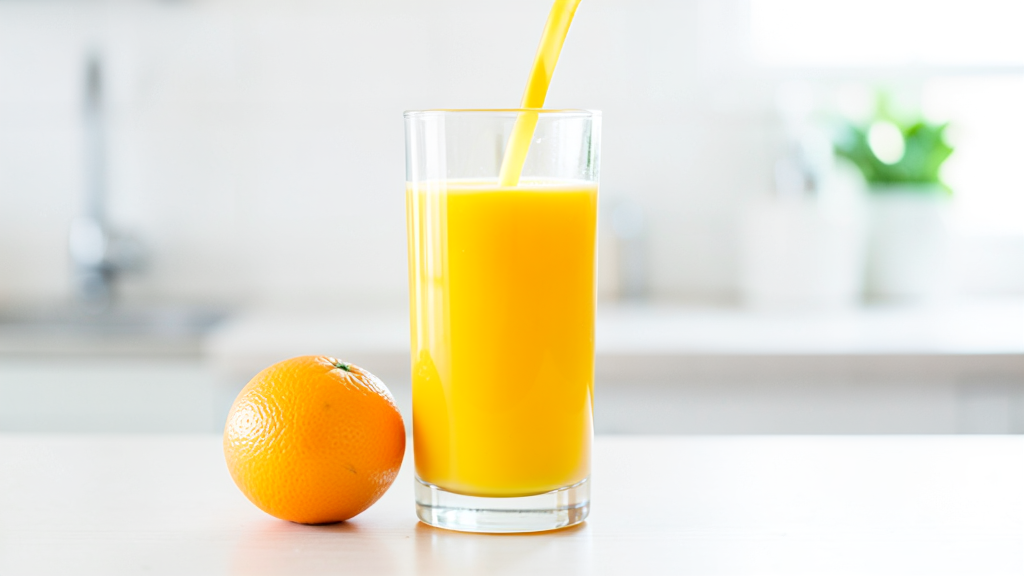
A glass of orange juice takes about four oranges and leaves most of what makes them food behind in the machine. That single fact is the whole argument about juicing – everything else is marketing on both sides.
I spent a phase blending everything and another phase juicing everything, and the difference in how I felt came down to fiber and speed of absorption, not to “living enzymes.”
What the blender takes with it
| Form | Calories | Sugar | Fiber |
|---|---|---|---|
| 1 orange (131 g) | 60 | 12.4 g | 2.4 g |
| 240 ml orange juice | 112 | 23.4 g | 0.5 g |
| 1 apple (182 g) | 95 | 19 g | 4.4 g |
| 240 ml apple juice | 140 | 32 g | 0.3 g |
| Blended whole fruit (smoothie) | same as fruit | same | mostly retained |
Two consequences. First, the sugar arrives without the chewing, satiety and gastric-slowing matrix – which is why juice counts as at most one of your five-a-day in UK guidance, no matter how many glasses. Second, a lot of the polyphenols live in peels and pulp (hesperidin in orange peel, quercetin in apple skin), so juicing discards them while blending keeps them.
Does juice “detox” anything?
No – and this is the part the industry never tested. The US National Center for Complementary and Integrative Health’s summary of cleanses and detoxes (NCCIH) is that there’s little evidence juice cleanses remove toxins, and the organs responsible for that already work without help. Where juice helps, it helps as a way to increase fruit and vegetable intake in people who otherwise eat none – a real but much smaller claim.
The fructose arithmetic
240 ml of orange juice contains roughly the fructose of three to four oranges, delivered in ninety seconds. Whole fruit distributes the same load over chewing, fiber and time. For people with IBS or fructose malabsorption, juice is also a much larger FODMAP dose than the fruit it came from – the fiber is what normally limits the dose.
Two more things people ask about:
- Vitamin C oxidation: yes, it falls after juicing and storage; a glass drunk immediately is fine, a bottle kept two days isn’t the same product.
- Oxalates: heavy green juicing (spinach, chard) raises oxalate load – relevant if you’ve had calcium-oxalate kidney stones. Our hydration article covers the fluid side of stone prevention.
How to do it without the downside
- Blend rather than juice when the ingredient list is fruit-heavy. You keep the fiber and the peel polyphenols.
- If you juice, dilute 1:1 with water and drink it with a meal containing protein or fat – the same glucose-blunting logic as the post-meal walk.
- Keep the pulp in the smoothie; it’s the part people strain out and the part with the polyphenols.
- One glass a day, not three. Three glasses is a sugar load with vitamin C on top.
- Vegetables first: a green-dominant juice has a fraction of the sugar of a fruit one – see how we treat supplement claims in the probiotics vs fermented foods piece.
Juice vs whole fruit, one week priced out
| Item | Juice route | Whole-food route |
|---|---|---|
| Cost per week (US avg) | $14-22 for 1.7 L | $6-9 for the same fruit |
| Prep time | 12-18 min + cleaning | 2-4 min |
| Satiety per 100 kcal | Low (liquid, no chewing) | High (volume + fiber) |
| Fiber per 1,000 kcal | ~2-4 g | ~18-25 g |
| Vitamin C retained after 48 h | Falls measurably | Stable |
The honest case for juice is narrow: it’s the cheapest way to move fruit and vegetables into someone who currently eats none, and it’s useful when appetite is the limit (illness, chemo, dentures, travel). It is not a delivery system for “cleaning”.
Who should be careful
- IBS or fructose malabsorption: apple and pear juice are among the highest-FODMAP ways to eat fruit; the same fruit whole delivers less free fructose per sitting.
- Kidney stones: heavy spinach/chard juicing raises oxalate load – see the fluid targets in our hydration article before adding a daily litre of green juice.
- Diabetes or prediabetes: juice blunts less than the same carbohydrate eaten whole; the gut article covers why the food matrix matters for more than glucose.
- Anyone on warfarin: large daily green-juice volume changes vitamin K intake, which moves INR. That’s a diet change, not a supplement interaction.
Two claims I stopped repeating
“Alkalizes your body” – juice doesn’t change blood pH; it changes urine pH, which is a kidney housekeeping job, not a health state. “Live enzymes” – pectinase, amylase and the rest are digested in the stomach like any other protein, and stomach acid denatures them within minutes. Both claims survive on packaging because neither can be falsified at the breakfast table.
What I keep in the fridge instead
Whole oranges and apples for eating; a bag of frozen berries for blending; a bottle of 100% tart cherry juice I use 30 ml at a time (the same product we discussed in the turmeric dosing piece – dose and form decide whether something is a food or a supplement). Blending takes four minutes and keeps everything the machine would have thrown away.
Evidence note: The nutrition figures are standard USDA values for raw orange, apple and 100% juices, and the “counts once” limit follows UK 5-a-day guidance for fruit juice. The detox conclusion follows the NCCIH review of cleanse and detox products; individual tolerance for fructose varies, so people with IBS should treat juice as a dose to test rather than a health food.