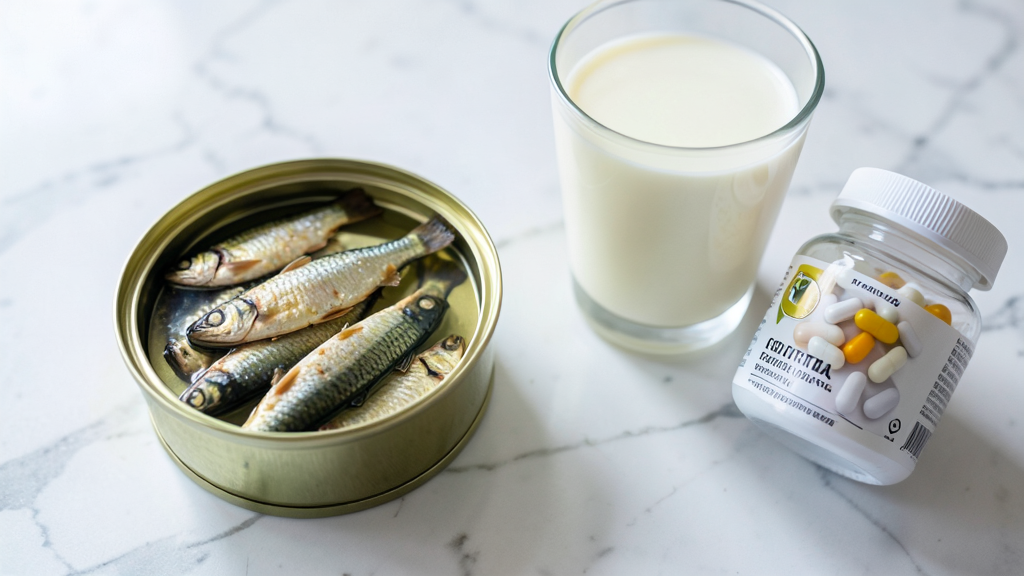
A 20-millilitre tube of blood settles a question most people guess at for years. Vitamin D is the supplement I get asked about more than any other, usually by someone who just heard a coworker “was at 12” and is now swallowing a 50,000 IU capsule bought over a gas station counter.
I spent the past two weeks back in the primary sources instead of the bottle labels: the NIH fact sheet, the 2024 Endocrine Society guideline, the fracture trials that actually ran for years. The picture is narrower than the marketing and a good deal more specific. Here it is in the form people ask it, as questions.
Do you need to supplement at all?
Some people do. Plenty don’t. If you’re 38, eat salmon more than once a fortnight, drink fortified milk and live under a sun that actually rises, you’re probably covered by diet and the multivitamin you take out of guilt. But four groups keep surfacing in the deficiency data: adults over 65, people with darker skin, people living above roughly the 37th parallel between November and February, and anyone with a BMI over 30 or a malabsorption problem such as celiac or Crohn’s disease.
Here’s why those groups specifically. Your skin makes vitamin D from cholesterol under UVB light, and every step of that process gets harder with age and with melanin. Fat tissue pulls the vitamin out of circulation, which is why a person weighing 110 kg needs roughly double the dose of a person weighing 70 kg to reach the same blood level. And the kidney’s conversion step slows after 65, which is why “just get some sun” stops being advice that works for your parents.
So the real question isn’t whether everyone should take vitamin D. It’s whether you’re in a group where the maths changes. We took the same position on vitamin B12: check the thing before you megadose it.
How much is enough, and where does it stop being safe?
Two numbers do most of the work. The federal nutrient recommendation is 600 IU (15 mcg) a day for adults 19 to 70 and 800 IU (20 mcg) after 70, with a tolerable upper intake of 4,000 IU a day for adults. The Endocrine Society’s 2024 clinical practice guideline is more generous for the groups above: 1,000 to 2,000 IU a day for healthy adults 19 to 74, and 2,000 IU for those 75 and older, while explicitly advising against routine blood testing in healthy adults under 75.
| Situation | What the guidance says | Where it comes from |
|---|---|---|
| Adult 19–70, general | 600 IU (15 mcg)/day | NIH Office of Dietary Supplements RDA |
| Adult 71 and older | 800 IU (20 mcg)/day | NIH ODS RDA |
| Healthy adult 19–74, prevention guideline | 1,000–2,000 IU/day | Endocrine Society, 2024 |
| Adult 75 and older | 2,000 IU/day | Endocrine Society, 2024 |
| Tolerable upper intake, adults | 4,000 IU/day | NIH ODS upper limit |
| Common prescription pattern | 50,000 IU weekly ≈ 7,100 IU/day | Short-term repletion, not a permanent habit |
That last row is where most of the confusion lives. A weekly 50,000 IU script averages out to about 7,100 IU a day, above the 4,000 IU ceiling. That’s reasonable for eight weeks while correcting a documented deficiency. It’s a strange thing to stay on for six years, and it’s how people end up hypercalcemic from a vitamin that was supposed to be harmless.
D2 or D3: is the extra money worth it?
Usually, yes. In a head-to-head trial in the New England Journal of Medicine, 1,000 IU a day of D3 raised circulating 25-hydroxyvitamin D to roughly double what the same dose of D2 did, and held it there longer. The 2024 guideline still calls both acceptable, because the gap narrows when D2 is dosed high. But at the shelf, where the difference in price is a dollar, cholecalciferol (D3) is the one that sticks.
One caveat worth knowing: vegans have a real reason to care. D3 is usually pulled from lanolin in sheep’s wool, and the lichen-derived version costs more but works identically.
Can the sun do it instead?
Sometimes, and far more efficiently than a pill. Fair-skinned adults make on the order of 10,000 IU from 15 to 20 minutes of midday summer sun on arms and legs. But that factory is weather-dependent. North of roughly the 37th parallel, essentially no cutaneous vitamin D is produced from November through February; daily SPF 30 blocks more than 95% of the reaction, which is the correct trade for skin cancer and the wrong trade for vitamin D.
So the person who wears sunscreen year-round and works near a window is often the same person who walks into a clinic at 18 ng/mL in March.
What does a blood result actually mean?
Ask for 25-hydroxyvitamin D, not 1,25-dihydroxyvitamin D. The second one is the active hormone, and it reads normal in most deficient people because parathyroid hormone drives it up. That’s how someone is told “you’re fine” while sitting at 14 ng/mL.
Interpretation, and this is where the two bodies disagree: under 12 ng/mL is deficient; 12 to 20 is inadequate; 20 ng/mL (50 nmol/L) is adequate for the great majority of the population by the federal standard. The Endocrine Society uses 30 ng/mL as its target when treating bone disease. Anything above 100 ng/mL is where toxicity gets discussed.
But didn’t a big trial say it doesn’t work?
Partly, and this is the part the headlines get right. A 2022 trial in the New England Journal of Medicine gave 2,000 IU a day, with or without 1,000 mg of calcium, to more than 2,500 adults aged 65 or older for three years and found no reduction in fractures overall compared with placebo. Large trials in US women found the same. What those studies tested was topping up people who were already replete, not correcting a documented shortfall — and that’s the distinction every “vitamin D doesn’t work” story quietly skips.
It also skips the population where the effect is largest: housebound older adults in care facilities, where supplementation plus calcium does reduce hip fractures. Replete people don’t gain. Deficient people do. That’s not a contradiction, it’s a nutrient.
What to actually do
- Under 70, healthy, no risk factors: 600 IU a day is the floor. Food and sensible sun count toward it; a 1,000 IU capsule is cheap insurance, not a medical necessity.
- 75 or older, or dark-skinned, or homebound: 2,000 IU a day is the guideline dose, and this is the group where testing is genuinely useful.
- On a 50,000 IU weekly script: ask what the baseline level was and when you’ll recheck it. Repletion is 8 to 12 weeks, not forever.
- Eating for it: 3.5 oz of salmon gives about 447 IU, a teaspoon of cod liver oil about 450 IU, a cup of fortified milk about 120 IU, one egg yolk about 44 IU. Diet alone rarely closes a real gap.
- Pair it with magnesium: the mineral is required to convert vitamin D into its active form, and it’s the more commonly under-consumed of the two — we compared the magnesium forms here.
And if you’re weighing vitamin D against a collagen jar for skin and joints, the evidence for the two is not equally strong — here’s what the collagen trials actually show.
Two sentences on the evidence. The dose figures above come from the NIH Office of Dietary Supplements fact sheet and the 2024 Endocrine Society clinical practice guideline, and the fracture findings come from a three-year randomised trial of 2,558 older adults published in the New England Journal of Medicine in 2022. Needs vary by age, skin tone, body composition and kidney function, so a clinician should set any dose above the 4,000 IU upper limit.