
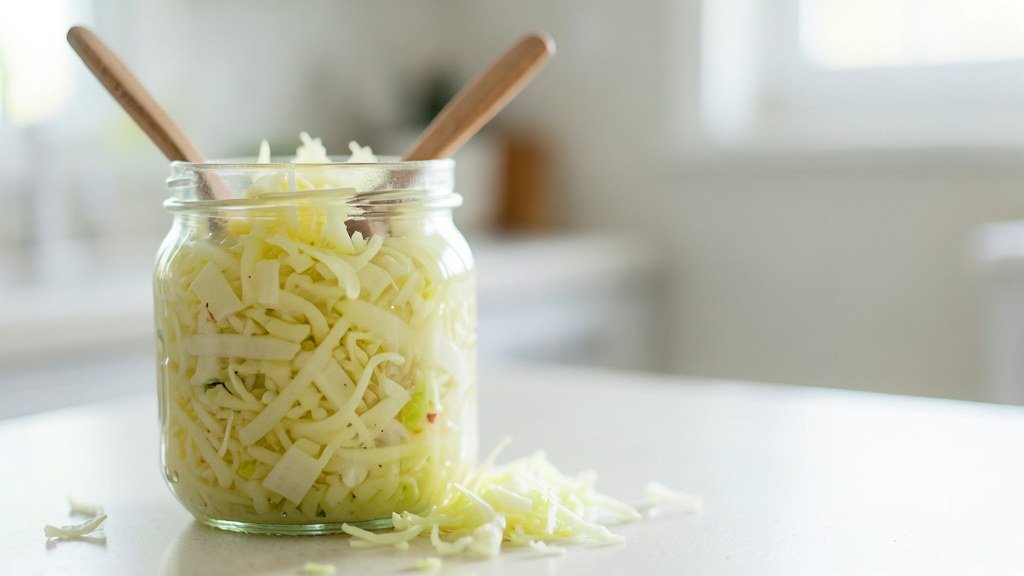
About 39 trillion. That’s the working estimate of microorganisms living in and on you – revised down from the older “ten times your cells” myth by a 2016 calculation from Sender, Milo and Fuchs. I keep that number in my head when people ask me whether to buy the $34 capsule or the jar of kimchi, because the honest answer is that those two things aren’t competing for the same job.
People ask it as one question. It’s actually two. And once you split them apart, the decision gets a lot cheaper.
The short answer
A capsule gives you specific strains in a counted dose. Fermented food gives you a moving community plus whatever those microbes made during fermentation – acids, gases, some vitamins – in a food you actually eat. One is a targeted intervention you can study in a trial. The other is a dietary pattern that shifts what your gut looks like over weeks.
So: if the goal is “fix this specific thing” (antibiotic-associated diarrhea, travel gut, a confirmed imbalance), the capsule is the tool with evidence. If the goal is “generally have a more diverse gut,” the food is the tool with evidence. Buying a capsule to fix your diet is where most money disappears.
What a capsule gives you that food can’t
Strain-level specificity, and a number on the label. That matters because probiotic effects are strain-specific – not a category effect. Here’s where the actual evidence sits, per the NCCIH fact sheet on probiotics and the trial literature:
| Strain | Best-supported use | Typical studied dose | Evidence strength |
|---|---|---|---|
| Lactobacillus rhamnosus GG | Antibiotic-associated diarrhea | 6-10 billion CFU/day | Moderate, several RCTs |
| Saccharomyces boulardii (a yeast) | Antibiotic-associated and C. diff diarrhea | 200-500 mg/day | Moderate |
| Bifidobacterium infantis 35624 | IBS bloating and discomfort | 100 million CFU/day | Small but repeated trials |
| Lactobacillus reuteri DSM 17938 | Infant colic | 100 million CFU/day | Mixed; strong in breastfed infants |
| Multi-strain “generic” blends | Most general gut claims | Varies wildly | Weak – often untested at that blend |
Two practical notes. CFU counts on the shelf are measured at manufacture, not at the moment you swallow them – so a bottle stored hot loses most of what it promised. And probiotics are mostly transient: they work while you’re taking them and fade within one to two weeks of stopping. They don’t move in.
What food gives you that a capsule can’t
Variety, and the leftovers. A single serving of traditionally fermented food can carry dozens of species, plus organic acids and fermentation byproducts a capsule doesn’t contain. The strongest human evidence for this side is a 2021 Stanford randomised trial (Cell, Wastyk et al.): people assigned to a high-fermented diet – about six servings a day for ten days gained roughly 25% more gut microbiome diversity, with small reductions in inflammatory markers. The “diverse diet” control arm, which just ate more fibre, didn’t move diversity much.
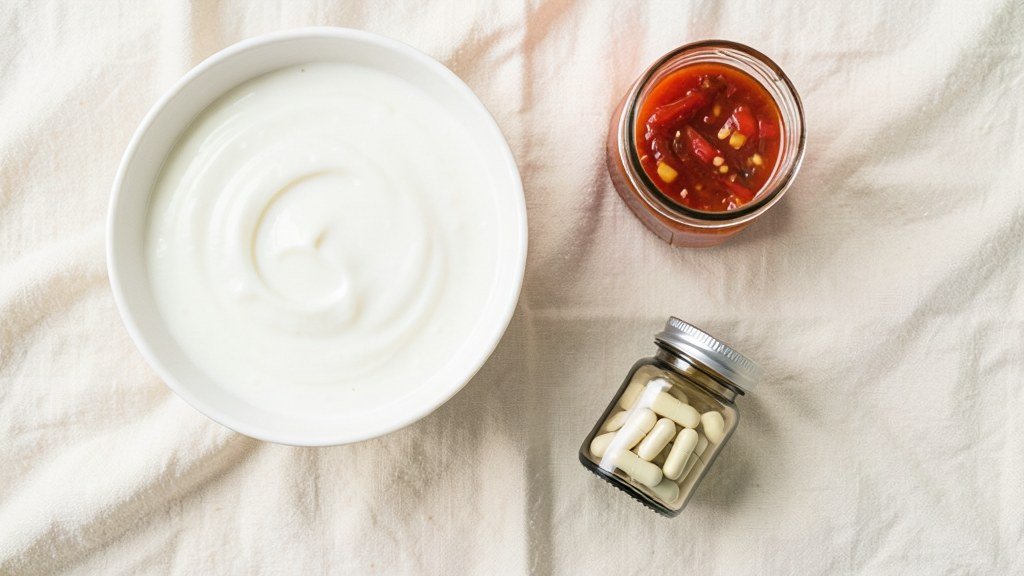
Here’s the shortlist I actually use, with the caveats that decide whether the jar counts:
| Fermented food | What’s in it | Catch |
|---|---|---|
| Yogurt (live-culture) | Lactobacillus, Streptococcus thermophilus | Pasteurised after fermentation = no live cultures |
| Kefir | Bacteria and yeasts from grains | Often 2-8 g sugar per cup in flavoured versions |
| Sauerkraut (raw/unpasteurised) | Leuconostoc and Lactobacillus spp. | Canned/shelf-stable jar = dead; must be refrigerated |
| Kimchi | Lactobacillus plantarum group, plus cabbage fibre | High sodium (~500 mg per 100 g) |
| Miso | Aspergillus oryzae-fermented soy | Add off-heat; boiling kills the cultures |
| Tempeh | Fermented soy, 19 g protein per 100 g | Cooked, so cultures are gone – the protein and isoflavones remain |
| Natto | Bacillus subtilis natto, vitamin K2 (MK-7) | Texture stops most people at the first spoon |
| Kombucha | Yeast + bacteria from a SCOBY | Sugar and caffeine; alcohol traces in some brands |
| Vinegar pickles | Nothing live (if pasteurised) | Vinegar ≠ fermentation; lacto-fermented only |
| Aged cheese | Some live cultures in raw-milk aged cheese | Most soft cheeses aren’t fermented in the probiotic sense |
Sourdough gets asked about constantly. The fermentation happens before baking, and baking kills the cultures – so it’s easier to digest, not a probiotic food.
Where each one stops working
The capsule stops at the label. If the strain isn’t named (or the label says only “proprietary blend”), there’s no trial to connect it to anything you want. If it’s been sitting in a hot warehouse since spring, the count is fiction.
The jar stops at pasteurisation. Most commercial sauerkraut and most vinegar pickles are pasteurised, which means you’re buying cabbage and salt. If it lives on an ambient shelf, it doesn’t count.
Both stop at antibiotics. If you’re on a course, take the capsule at least four hours away from the dose – and keep eating the fermented foods, since the food route is what rebuilds variety afterwards.
What I actually do
Six-ish servings a week, not a day: yogurt most mornings (the same one I use in the high-protein breakfast ideas I keep repeating), raw sauerkraut on plates two or three times, miso off the heat once a week, kimchi when it’s on sale. I keep one capsule of L. rhamnosus GG in the fridge for the two weeks a year I’m on antibiotics – and I don’t pretend it replaces the food. If you’re rebuilding the whole gut picture rather than one meal at a time, our longer guide on how to improve gut health naturally covers the fibre and sleep side; the supplement shelf beyond probiotics is in how much omega-3 you actually need.
Evidence note: The strain-by-strain summary follows the NCCIH (NIH) probiotics fact sheet and the randomised trials it cites, and the diet-diversity result is from Wastyk et al., Cell 2021 (Stanford, high-fermented vs control arms, ten days). The 39-trillion microorganism estimate is Sender, Milo and Fuchs 2016 – and individual responses vary with baseline microbiome, medications and immune status, so treat “more is better” as unproven.